
3.8.1 Radioactivity
3.8.1.1 Rutherford scattering
Content
- Qualitative study of Rutherford scattering.
- Appreciation of how knowledge and understanding of the structure of the nucleus has changed over time
Qualitative study of Rutherford scattering.
It is thought that the Greeks were the first to theorise the existence of ‘atoms’, and the word ‘atom’ itself comes from the Greek for indivisible. The first model put in place was called the plum pudding model, proposed by J.J Thompson. He said that atoms are discrete objects made up of pieces of positive and negative charge, with very small electron particles within an overall positive charge. This model represented known knowledge at the time, but was revolutionised after Rutherford’s scattering experiment. At this point, atoms were also thought of as solid objects.
Rutherford’s experiment consisted of firing a high energy beam of alpha particles (of the same EK) at a very thin gold foil. From the existing knowledge on the atom at the time, he expected a beam of alpha particles should be scattered, but not by much, due to this ‘spread of positive charge’. However, he observed remarkably that some of the particles rebounded back in the same direction.
In his experiment, most alpha particles passed through the foil with almost no deflection, only around 1 in 2000 were deflected. Although around 1 in 10000 were deflected over angle of more than 90°.
This experiment led him to propose the idea of a concentrated nucleus of positive charge within the atom (because positive charge was deflected when passing too close). It also led to the conclusion that the nucleus is extremely small relative to the size of the atom.
From these results Rutherford also estimated the size of the nucleus. It can be said the probability of an alpha particle being deflected by an atom is 1 in 10000n, n being the number of layers of atoms. This probability comes from the ratio of the cross-section of the nucleus to that of the atom. So you get 1/4pd2 / 1/4pD2 = 1 / 10000n, where d = diameter of the nucleus, and D the diameter of the atom. You can rearrange this equation to give you d2 = D2 / 10000n. Then, if you assume a standard value for the number of layers of atoms, you can take n = 10000. Substitute this value of n in and solve for d to get d = D/10000 which gives you the size of a nucleus relative to an atom.
Appreciation of how knowledge and understanding of the structure of the nucleus has changed over time
3.8.1.2 α, β and γ radiation
Content
- Their properties and experimental identification using simple absorption experiments; applications eg to relative hazards of exposure to humans.
- Applications also include thickness measurements of aluminium foil paper and steel.
- Inverse-square law for radiation: I=k/x2
- Experimental verification of inverse-square law
- Applications eg to safe handling of radioactive sources.
- Background radiation; examples of its origins and experimental elimination from calculations.
- Appreciation of balance between risk and benefits in the uses of radiation in medicine.
Their properties and experimental identification using simple absorption experiments; applications eg to relative hazards of exposure to humans.
There are three types of radiation, alpha, beta and gamma radiation.
The general equation for radioactive decay involves a nuclide zAX where A is the mass number and Z is the proton number.
Alpha (a) radiation is the emission of a helium nucleus – two protons and two neutrons. This emission occurs from the nucleus of an unstable atom. Alpha radiation has a relatively large mass and charge relative to beta and gamma radiation. Due to this property, alpha radiation is the least penetrating of the three types of radiation, however it is the most ionising and readily knocks electrons off nearby atoms. Alpha radiation is absorbed by paper/skin amongst many other materials.
A general equation representing alpha decay is shown below:
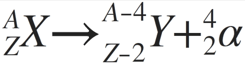
Beta (b) radiation is the emission of an electron from an unstable nucleus. Clearly the nucleus does not contain any electrons, so a neutron is changed into a proton, or vice versa, for b– or b+ decay respectively. The b radiation can either be b– or b+, where the beta minus decay involves emission of an electron, and beta plus, a positron (a positron is the electrons antiparticle). In beta minus decay the emission is accompanied by an antineutrino, and in beta plus decay a neutrino (the neutrino ensures conservation of energy). Moreover, beta radiation is more penetrating than alpha radiation, but less ionising than it. The beta particles produce fewer ions per unit length along their path than an alpha particle, provided the length is small as alpha particles have a short range in air. Beta particles are absorbed by around 5 centimetres of metal.
A general equation showing beta minus decay is given below. Beta plus decay is identical, except a positron is released (beta plus particle), and an electron neutrino (as opposed to the antielectron neutrino)

Gamma (g) radiation occurs in conjunction with alpha and beta decay. After alpha or beta decay, the nucleus is left in an excited state, expelling this excess energy in the form of a gamma ray (photon). These photons are highly penetrating and are not stopped, however can be absorbed. Gamma radiation has the lowest ionisation abilities, as they simply pass through most substances without any interaction. The inverse-square law can be applied to gamma radiation, as intensity decreases proportionally the the square of the distance ie I = k 1/r2, where k is a constant to be determined. Gamma radiation is absorbed by a few centimetres of lead.
A general equation for gamma decay is shown below

These decays are summarised, with their respective equations, in the picture below

Source: http://www.physbot.co.uk/nuclear-physics.html
The properties of the three types of radiation are given below:
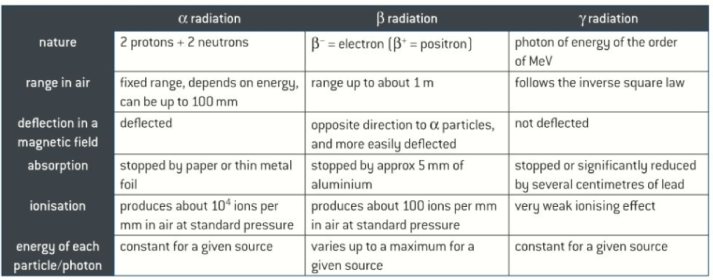
Source: https://www.kerboodle.com/api/courses/17892/interactives/137640.html
Rutherford also undertook studies into radioactivity. At this time, only alpha and beta types had been discovered. He realised that radiation ionised air, so conducts electricity. He could therefore make a detector to detect this ionising ability. Then he conducted further tests to show the deflection of alpha and beta radiation, and from the direction of deflection, the positive charge of alpha radiation was determined, and the negative nature of beta radiation. (Although now we know that there is also a beta plus decay). Also, this experiment shows gamma rays are uncharged as they are not affected by a magnetic field.
A Geiger counter can be used to investigate the absorption of radiation by different materials. You must place a Geiger tube at a fixed distance from a radioactive source, dependent on the type of radiation being studied. You must first, using the Geiger tube, measure the background count rate with no source present as this will need to be subtracted from your count rates for the source. Then, placing different absorbers in front of varying types of radiation ie paper and alpha radiation, you can investigate the effect of different materials on absorption.
You can use the set up shown below to investigate the ionising abilities of each type of radiation.
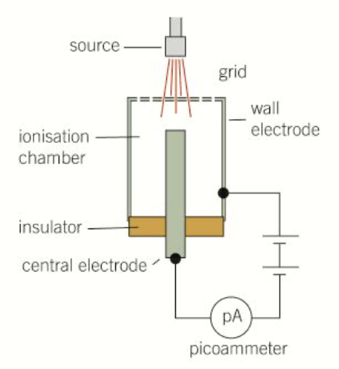
https://www.kerboodle.com/api/courses/17892/interactives/137640.html
In this experiment, as ions are created, the ions are attracted to the electrode holding an opposite charge. They are then discharged and electrons are able to form a current in the circuit, the value of which can be determined by the picoammeter. The current produced is proportional to the number of ions per second created in the chamber.
Cloud chambers can be used to determine the properties of radiation as well. Alpha and beta particles both ionise air, so leave a trail of water vapour droplets. The observed results show that all alpha particles from the same source have the same range, as they all travel the same distance in the cloud chamber. You can infer from this that each source gives the alpha particles a fixed amount of kinetic energy. Beta particles do not ionise air as well as alpha particles, thus their tracks are less easy to follow. Also, beta particles are released with a range of kinetic energies up to a maximum, so will all travel different distances.
Applications also include thickness measurements of aluminium foil paper and steel.
Radiation can be used in determining the thickness of materials like aluminium foil paper and steel. Thicker materials will absorb more radiation, so less radiation would reach a detector placed behind the material. This information can be used to determine the thickness of the material. The preferred type of radiation in these applications is beta minus. Alpha particles are not suitable as they are stopped by paper. Also, gamma rays would pass through the materials every time so it would not be useful to use.
Inverse-square law for radiation: I=k/x2
Any physical quantity that follows the inverse square law will decrease with inverse proportion to the square of the distance from the source. Radiation intensity follows the inverse square law, this means that I is proportional to 1/x2, therefore I = k/x2 where k is a constant. I represents intensity (Wm-2), x represents distance (m). The units of k can then be found to be the watt (W), because Wm-2 x m2 = W.
Experimental verification of inverse-square law
To verify the inverse square law, you can use a Geiger-Muller tube, a metre ruler and a radioactive source. First you must measure the background count at a significant distance from the source. Then you could start with the source at 10cm from your zero point, and increase this linearly up to 100cm for example. You would need to subtract the background count from the measured count rates at each distance and then plot a graph of this corrected-count rate against distance. From your graph you can check that as the distance doubles, the count rate decreases by a factor of four. You could also then draw a graph of count rate vs distance2, which should yield a straight line. Also it should be noted that count rate is used as a substitute to intensity.
Applications eg to safe handling of radioactive sources
There are procedures that must be followed when attempting to handle radioactive sources safely. For example, if the source you are using is solid, it must be handled using equipment like tongs. This is to ensure that the source is as far away from the person as possible, thus in an effort to reduce exposure ie beyond the range of alpha/beta radiation, or to reduce the intensity of gamma radiation as low as possible. Moreover, you must use sealed containers made of lead for example, to store the radioactive sources, whether they are in solid, liquid or gas form. This is to ensure that a radioactive gas could not be breathed in, or a liquid could not come into contact with skin, or be drunk. It is also vital that the radioactive sources are not used for longer than necessary, as to reduce exposure time and reduce the dose of radiation received. Also, there are regulations that ensure any time a radioactive source is used, it must be recorded in a log book.
Background radiation; examples of its origins and experimental elimination from calculations.
Background radiation occurs naturally all around us from various sources. For example, you have the uniform microwave radiation (cosmic rays) that still remain from the Big Bang. Also certain rocks are radioactive and give off radon gas. Plants will also absorb radioactive materials from the soil and these are able to pass up the food chain. You will get background radiation from nuclear fallout ie Chernobyl, and from the use of nuclear weapons. Pilots are exposed to higher doses of background radiation as levels are higher as you increase in altitude from the surface of the earth.
In calculations regarding the activity (amount of nuclei of the isotope that decay per second), the background radiation count must be removed from the data obtained. For example if you used a Geiger counter to find the activity of a gamma source, you would first obtain a measurement of the background radiation level at a distance from your source (so the source does not interfere with your measured value). You can repeat this multiple times and calculate a mean, for experimental accuracy and then from your measured count for the source, subtract the background count from each value to give a truer value of the actual activity of your source.
Appreciation of balance between risk and benefits in the uses of radiation in medicine.
Ionising radiation is able to destroy the membranes of cells, which causes cell death. It can also damage important biological molecules such as DNA, which can cause cancerous tumours as it can stimulate cells to divide uncontrollably. It can cause genetic effects if it causes a mutation in a sex cells as these could be passed on to offspring. Also it can have an affect on living cells other than reproductive cells (somatic cells), thus somatic effects which can be detrimental to a person’s health. High doses will simply kill cells, although mutation of cells can occur at both high and low doses.
This means that people using equipment that produces ionising radiation, or people at higher exposure to ionising radiation, wear something called a ‘film badge’ to display exposure levels. The various types of radiation can be detected, and if levels are too high action must be taken.
In medicine these risks are very real as nuclear radiation is used for example, in sterilising medical equipment or helping to diagnose and treat cancer. Gamma rays are able to pass through medical equipment like syringes, so can be used to inactivate viruses and kill bacteria.
Radioactive tracers can be used to find areas of disease and investigate the inside of a person’s body without requiring surgery. Although doses must be limited due to the risks of the radiation. Radioactive tracers must have a half-life long enough for the measurements that are required, but short enough so that it will decay quickly after use and can be disposed of.
Gamma rays can also be directed onto tumours (groups of potentially cancerous cells), which then destroys these cells. Although it is crucial exposure time is limited, otherwise too many normally functioning body cells will be killed in the process.
3.8.1.3 Radioactive decay
Content:
- Random nature of radioactive decay; constant decay probability of a given nucleus; ΔN/Δt = – λN
- The equation:

- Use of activity, A = λN
- Modelling with constant decay probability
- Questions may be set which require students to use

- Questions may also involve use of molar mass or the Avogadro constant
- Half-life equation: T1/2 = ln2/λ
- Determination of half-life from graphical decay data including decay curves and log graphs
- Applications eg relevance to storage of radioactive waste, radioactive dating etc.
Random nature of radioactive decay; constant decay probability of a given nucleus; ΔN/Δt = -λN.
Radioactive decay is a completely random process, and is carried out by alpha/beta/gamma emission in order to make an unstable nucleus more stable. Radioactive decay can be modelled by the equation ΔN/Δt = -λN. In the equation N = number of nuclei present and t is time (s). l is called the decay constant, carrying the unit s-1.
It can be said that the rate of disintegration of the number of nuclei present is proportional to the number of nuclei present, ie -ΔN/Δt N (the negative sign represents the decrease in number). The constant of proportionality is called the decay constant, denoted by lambda, thus giving the equation ΔN/Δt = – λN.
The equation 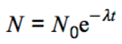
This equation can be used to find N0 (the initial number of nuclei present). It can be derived using the equation in the previous point, although its derivation is not required, but is shown below as it can help with the understanding of the equation. The derivation requires integration techniques you may or may not be familiar with.
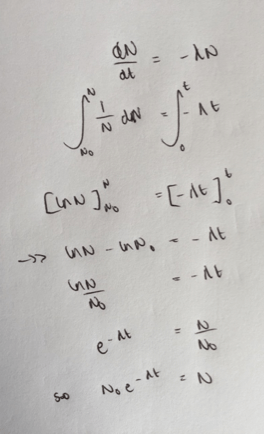
This equation can therefore be used to find the number of nuclei present at a given time, if you know the initial value N0, the decay constant, and time elapsed.
Use of activity, A =λN
The activity of a sample is defined as ‘the number of nuclei of the isotope that decay per unit time (ie per unit second)’, or it can be looked at as the rate of disintegration of a nucleus, thus A = -ΔN/Δt. And since we already know that -ΔN/Δt = λN, then it must be true to say A = λN. The units of activity are the Becquerel (Bq)
Modelling with constant decay probability
The probability of decay is a constant.
Questions may be set which require students to use 
The derivation of the equation above is shown below. Again, it is not required, but useful for understanding the concept. A0 represents initial activity (ie activity at t = 0).

Questions may also involve use of molar mass or the Avogadro constant
An element with mass number A will have a molar mass equal to its mass number in grams, and one mole of the element contains 6.023 x 10²³ atoms, which is called the Avogadro constant (NA). So for carbon 12 (12C), 6.023 x 10²³ atoms of carbon-12 = 12g. Its molar mass (ie the mass of one mole of carbon) is 12g.
Half-life equation: T1/2 = ln2/λ
The half-life (T1/2) of a radioactive isotope is defined as ‘the time taken for the mass of the isotope to decrease to half the initial mass, or, time taken for the activity to half’
From this definition, we can say that the half-life occurs when N = 0.5N0. We can substitute this value of N into the equation  to derive a value of t that will be the time taken for half-life to occur (so when t = T1/2). In the derivation I have used a lowercase t, however it should be uppercase.

Determination of half-life from graphical decay data including decay curves and log graphs
From a graph of N vs t, where N = N0/2, the corresponding value of t is the first half life. The time taken for this value to halve will then be the second half life time, which should be identical. However, if you are asked to calculate the half life from this type of graph, always find as many values for T1/2 as the graph will allow you, and calculate a mean value.
For the ln(N) graph, the gradient is equal to -λ, thus to calculate half life, T1/2 = ln2/λ, so substitute l into this equation to find half life.

Applications eg relevance to storage of radioactive waste, radioactive dating etc.
Half-life is an important concept when examining the safety of radioactive waste, or use in radioactive dating.
Carbon dating can be used to find the age of an object containing organic material. It only applies to matter which was once living, and in an equilibrium with the atmosphere. Cosmic rays lead to the formation of the isotope carbon -14 by bombarding nitrogen nuclei. This carbon isotope then combines with oxygen, forming carbon dioxide which can be incorporated into living things ie through photosynthesis in plants/trees etc. The rate of production of carbon -14 appears to be constant. So if you measure the activity of a sample then compare its activity to that of the same mass of living material now, you can calculate an estimate for the time that should have passed for its activity to decrease to your measured value. This is also made reliable by the fact that once a tree for example, has died, it will take no more carbon dioxide in.
Example: A sample of dead organic material is found to have an activity of 0.5Bq. An equal mass of living organic material of the same type, is found to have an activity 1.8Bq. Estimate the age of the sample given that the half life of carbon – 14 is 5570 years. Give your answer to a suitable number of significant figures.
So an equation that will give us a value of time is  and we also know A = lN. So we can calculate the value of N for the living material, and the value of N for the dead material. The value of N we find for the living material (providing the rate of carbon – 14 production, and its relative concentration in the atmosphere, has remained constant), will give us the value of N that the sample would have started at when it was living. Another way of writing this is N0 (when t = 0). The decay constant also needs to calculated, which can be done using λ = ln2/T1/2.
So now we have all of the information we require to solve for t, which is shown below.

Potassium-Argon dating can also be used to estimate the age of samples ie rocks. It is useful because argon is chemically unreactive, so would not be expected to be found naturally inside of a rock, so any found is very likely to be from radioactive decay of potassium into argon.
Potassium decays by either beta decay, or by electron capture. It is 8x more likely to decay by beta emission to form the calcium isotope 40 Ca, than to decay via electron capture. This means that in a sample, if you now have 4 potassium-40 atoms to every 1 argon-40 atom, then N = 4 now, but N0 = 13 because there would have originally been 13 potassium-40 atoms, 8 of which decayed into the calcium-40 isotope, 1 of which to argon-40, leaving 4. This can be then substituted into N = N0…, alongside λ = ln2/T1/2 to give the age of the sample as over 2000 million years.
3.8.1.4 Nuclear instability
Content:
- Graph of N against Z for stable nuclei.
- Possible decay modes of unstable nuclei including α, β–, β+ and electron capture.
- Changes in N and Z caused by radioactive decay and representation in simple decay equations. Questions may use nuclear energy level diagrams.
- Existence of nuclear excited states; g ray emission; application eg use of technetium -99m as a g source in medical diagnosis
Graph of N against Z for stable nuclei.
The graph above shows the curve for stable nuclei. The stable nuclei lie between the origin and around N = 120, Z = 80, where N = neutron number, Z = proton number.
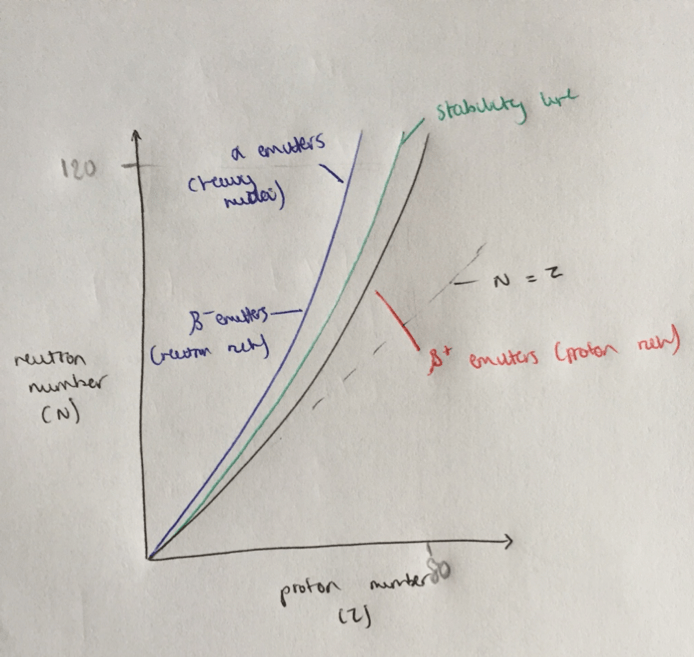
- For Z < 20, the stable nuclei follow the line N = Z.
- For Z > 20, the stable nuclei have more neutrons than protons. These extra neutrons serve to help nucleons bind together without adding more electrostatic repulsion between protons.
- For Z ³ 60, you will get alpha emitters. Usually for these alpha emitters Z > 80, and N > 120. These nuclei are too large to be stable because the strong nuclear force becomes insufficient to overcome the electrostatic repulsion between the vast amount of protons.
Possible decay modes of unstable nuclei including α, β–, β+ and electron capture.
Alpha omission reduces both the N and Z value by 2, so alpha emitters move diagonally downwards, to the left.
β– emitters are found to the left of the N-Z stability curve because they are neutron rich. They convert a neutron to a proton in the nucleus to become more stable and move closer to the stability curve (diagonally downwards to the right).
The opposite can be said for β+ emitters as these are found to the right of the stability curve, since they are proton rich. These emitters will then move diagonally upwards to the left.
Another type of decay for an unstable nucleus is electron capture. This occurs when an unstable nucleus pulls an orbital electron from the first shell into its nucleus. Here, the electron combines with a proton, forming a neutron and neutrino. The neutrino is ejected from the nucleus, the neutron remains, an X –ray is also released in this process. An example of electron capture is given below. The nucleus formed will now have one more neutron and one less proton, thus becoming more stable. On the N-Z graph, it would cause a movement diagonally upwards, to the left, like the translation you would get from beta plus emission

Changes in N and Z caused by radioactive decay and representation in simple decay equations. Questions may use nuclear energy level diagrams.
The changes in N and Z caused by radioactive decay for alpha, beta plus and minus are given below. Also, simple decay equations are given for them.
Alpha decay = Z – 2, N – 2
β- decay = N – 1, Z +1
β+ decay = N + 1, Z – 1 (also the same for electron capture)
Gamma = N + 0, Z + 0

Existence of nuclear excited states; γ ray emission; application eg use of technetium -99m as a g source in medical diagnosis
Just like we can model electrons as having different excited states, we can model the nucleus in the same way. Unstable nuclei may emit a γ ray after alpha/beta decay or possibly electron capture. In this way, if the ‘daughter’ nucleus is given energy to move into an excited state, it is able to lose energy by releasing a photon of energy, allowing the nucleus to move to its ground state (lowest energy state). The term ‘daughter nucleus’ refers to the nucleus remaining after emitting an alpha or beta particle, or undergoing electron capture.
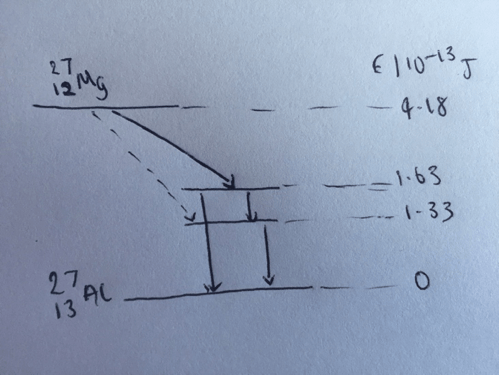
The energy levels of nuclei will usually be represented as shown below. The magnesium-27 has decayed by β– decay to produce aluminium-27, and has decayed to leave its nucleus in an excited state. Just like with the electron energy levels, the nucleus may have a few energy levels. Take for example the diagram below, the nucleus has two energy levels, and can decay straight from 1.63 x 10⁻¹³ J to 0J at ground state in one process. Or it can move down one energy level and release 0.3 x 10⁻¹³ J, and then fall down to ground state from the slightly lower energy level, thus releasing two photons of energy.
Another key term associated with these nuclear excited states are metastable states. These states are excited states of an atom that have a much longer lifetime than that of the other states, but a shorter lifetime than the stable ground state. So atoms could stay in this metastable state for a considerable amount of time, long enough for them to be separated from the parent isotope. This concept is utilised in medical diagnosis, using technetium-99m as a gamma source.
Nuclei of the technetium-99 form in a metastable state, hence the notation technetium-99m. It is also written as 99Tcm to indicate this metastable state. This 99Tcm is formed by beta minus decay of 99Mo. This technetium-99m has a half life of around 6 hours, and when this technetium decays to ground state it releases a γ ray. Once this decays to its ground state, it forms a stable product with a half life of over 500000 years. This means that virtually only γ rays are obtained, which is useful in medical diagnosis because:
- You can use it to monitor blood flow through the brain
- There is such thing called a g camera, which can be used to gain insight into internal organs and bones by detecting g rays from places the 99Tcm is located inside of the body.
3.8.1.5 Nuclear radius
Content
- Estimate of radius from closest approach of alpha particles and determination of radius from electron diffraction.
- Knowledge of typical values for nuclear radius.
- Students will need to be familiar with the Coulomb equation for the closest approach estimate.
- Dependence of radius on nucleon number:
- R = R0A1/3 derived from experimental data.
- Interpretation of equation as evidence for constant density of nuclear material.
- Calculation of nuclear density.
- Students should be familiar with the graph of intensity against angle for electron diffraction by a nucleus.
Estimate of radius from closest approach of alpha particles and determination of radius from electron diffraction.
The closest approach of an alpha particle to a nucleus can be used to give an estimate for the radius of a nucleus.
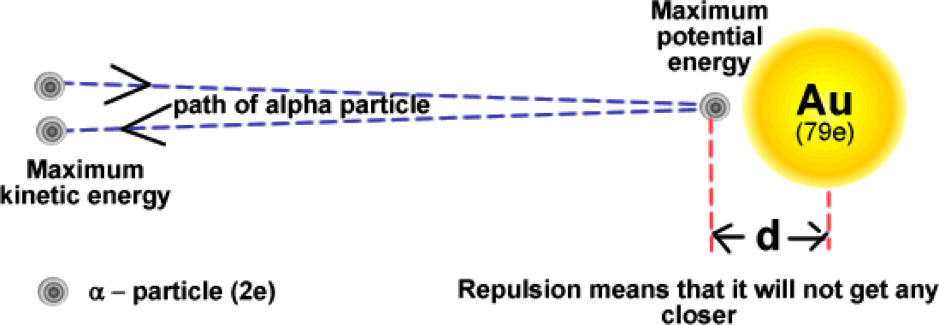
Essentially, as an alpha particle approaches a nucleus (for example a gold atomic nucleus), it will have a known kinetic energy = mv2/2. It experiences repulsion by the positively charged gold nucleus which increases as it gets closer, so the alpha particle will reach a certain distance and then reverse its path.
When the alpha particle reaches its closest approach (to the nucleus), all of its kinetic energy has been converted to electric potential energy. At this point, Ek = kqQ/d, where k = 1/4pe0. The equation can be rearranged to get d = kqQ/EK. Where q is the charge on the alpha particle, and Q is the charge on the (gold) nucleus.
The distance d calculated will give an estimate for the size of the nucleus, however the alpha particle will not come into direct contact with it, so the value calculated will be slightly too large.
Source: http://www.cyberphysics.co.uk/topics/atomic/Rutherford/Rutherford_calcs.htm
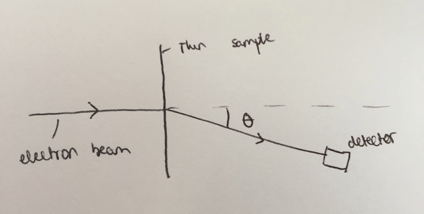
Electron diffraction can be used to determine the diameter of a nucleus. You can use the diffraction grating equation dsinθ = nλ to determine the diameter of the slit, ie the diameter of a nucleus. If you take the first order, the then the equation becomes dsinθ = λ, so d =λ/sinθ, clearly you need to know the angle of diffraction. Also you need to know the wavelength of the electron, which can be calculated using λ = h/mv. Since the electrons are being accelerated to incredibly high potentials, their speed can be approximated as ‘c’, thus λ = h/mc. Also, since E = mc2, we can write λ = hc/E. In this way, we can calculate the wavelength of the electron, substitute in our values and calculate an estimate for the nuclear diameter, which can be used to determine the radius of the nucleus.
The diagram below shows a simplified version of electron diffraction to estimate the diameter of a nucleus
Knowledge of typical values for nuclear radius.
The nuclear radius usually takes a value of around 5 x 10-16, as a typical value for the diameter of an atom is around 1 angstrom (10-10m).
Students will need to be familiar with the Coulomb equation for the closest approach estimate.
This has been covered in the first point. It is linking the equation for electric potential energy = kQq/r to the kinetic energy of the alpha particle.
Dependence of radius on nucleon number:
The radius of nuclei depends on the nucleon number of the atom. This should be a fairly logical argument to visualise, as more nucleons should result in more space occupied by the nucleus, thus a larger radius.
R = R0A1/3 derived from experimental data.
This equation was derived from experimental data as opposed to theory. A is the nucleon number (mass number), R is the radius. If you draw a graph of R against A1/3, you will get a straight line with the gradient equal to r0, where r0 is a constant = 1.05fm. Also, a graph of lnR against lnA yields a straight line where the gradient is equal to 1/3, and the y intercept is lnr0.
Interpretation of equation as evidence for constant density of nuclear material.
If you make the assumption that the nucleus is a perfect sphere, then you can say that its volume is 4πr3/3. From this you can determine that its density is proportional to mass number divided by the radius3, thus the density will be constant.
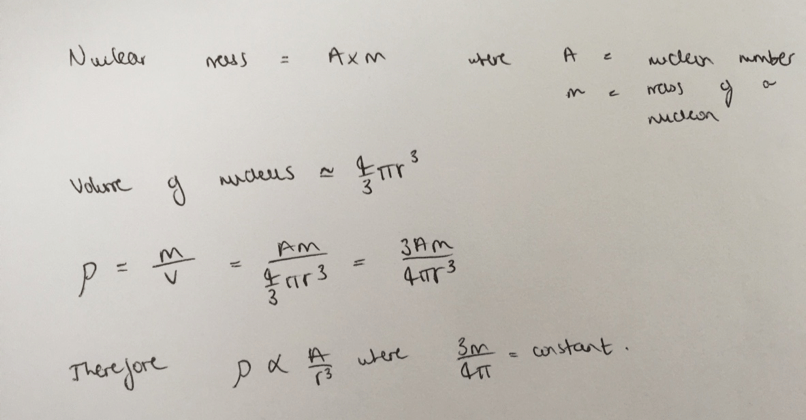
The volume can be shown to be proportional to the mass number, which also alludes to the fact the density of the nucleus is a constant, independent of radius. This means the nucleons are evenly distributed throughout the nucleus.

Calculation of nuclear density
We can say that V = 4π(R0)3A/3, so density = m/v = 3Am/4π(R0)3. We know the value of R0 to be 1.05fm, we can take A = 1 ie for Hydrogen (although any atom will yield the same result), and we can say m = u (atomic mass unit ie mass of one nucleon). If we plug in those values, you will find the nuclear density to be approximately 3.4 x 10¹⁷ kgm-3.
Students should be familiar with the graph of intensity against angle for electron diffraction by a nucleus.
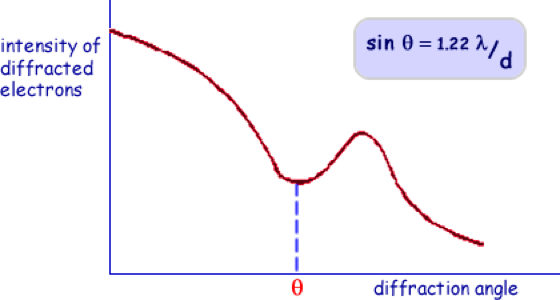
Source: http://www.cyberphysics.co.uk/topics/atomic/electron_diffraction.html
It says sinq = 1.22λ/d, the 1.22, for this specification, can be ignored (unless specified otherwise).
The graph shows intensity of diffracted electrons vs diffraction angle. You should make yourself familiar with this graph as you may be asked to draw it.
Another thing worth noting is the value of θ shown on the graph is θmin.
3.8.1.6 Mass and energy
Content
- Appreciation that E = mc2 applies to all energy changes,
- Simple calculations involving mass difference and binding energy.
- Atomic mass unit, u.
- Conversion of units; 1 u = 931.5 MeV.
- Fission and fusion processes.
- Simple calculations from nuclear masses of energy released in fission and fusion reactions.
- Graph of average binding energy per nucleon against nucleon number.
- Students may be expected to identify, on the plot, the regions where nuclei will release energy when undergoing fission/fusion.
- Appreciation that knowledge of the physics of nuclear energy allows society to use science to inform decision making.
Appreciation that E = mc2 applies to all energy changes
The equation E = mc2 is probably one of the most famous equations of all time, where E = energy, m = mass, and c = speed of light. It applies to any situation where energy is released or gained from an object. For example, a light bulb radiating 5W of power for a year, would release PΔt = Work done = 1.6 x 10⁸J. Converting this to equivalent mass, E/c2 = 1.7 x 10⁻⁹kg, so negligible compared to the mass of the bulb. This example however, serves to show that it can be applied to any energy change. Moreover, an antiparticle and particle annihilating produces 2 photons, where each photon has energy mc2.
The energy changes are usually only important in nuclear reactions, as only on this scale are they significant. Any change where energy is released, the total mass after will be less than total mass before (some of the mass is converted to energy).
Simple calculations involving mass difference and binding energy.
The binding energy of a nucleus is defined as ‘the amount of work that must be done to separate a nucleus into its constituent neutrons and protons.’ When you get a nucleus form from individual nucleons, energy is released because the strong nuclear force does work to pull them together. This energy released is what is called the binding energy of the nucleus, and because of this energy released when the nucleus forms from separate nucleons, the mass of a nucleus is marginally less than the mass of the separate nucleons (E=mc2). On the contrary, separating the nucleus into its individual constituents requires a lot of input energy, which is converted back to mass to restore the nucleons to their usual mass outside of the nucleus.
The mass defect (Δm) of a nucleus is defined as the difference between the mass of the separated nucleons and the mass of the nucleus. The mass defect is equal to the mass of individual protons added to the mass of individual neutrons (outside of the nucleus), subtract the mass of the nucleus (this mass will be lower).
This mass defect is due to the energy released after a nucleus forms from separate nucleons, so you can convert this ‘mass defect’ to energy using E = Δmc2, and this will give you the binding energy of a nucleus.
Atomic mass unit, u.
The atomic mass unit is 1/12th the mass of an atom of carbon-12. Carbon-12 has 6 protons and 6 neutrons, so 1/12th the mass is the average of the proton and the neutron rest mass. It has the value of approximately 1.661 x 10⁻²⁷kg.
Conversion of units; 1 u = 931.5 MeV.
The equation E = mc2 can be used to find equivalent energy value of 1.661 x 10⁻²⁷kg. So it can be said E = (1.661 x 10-27) x (3 x 108)2. Then to convert this value of E to MeV, we simply divide E/1.6 x 10-19 x 106 = 931.5 MeV.
Fission and fusion processes
Nuclear Fission: this occurs when an unstable, heavy nucleus splits into two fragments of similar size. Fission does not usually occur naturally, and it is induced fission that we can make use of. Induced fission is a process that occurs in U-235 when it is bombarded with neutrons. The only other fissionable isotope is Pu-239.
Nuclear Fusion: this is when two nuclei combine to form a larger nucleus. To combine two nuclei together, you must provide huge amounts of energy. This energy is the binding energy, and when two lighter nuclei fuse together, the binding energy per nucleon increases, as nucleus becomes more stable (up to the nuclear mass of iron).
Energy released in nuclear fusion/fission is equal to the change in binding energy.
Simple calculations from nuclear masses of energy released in fission and fusion reactions.
Graph of average binding energy per nucleon against nucleon number.
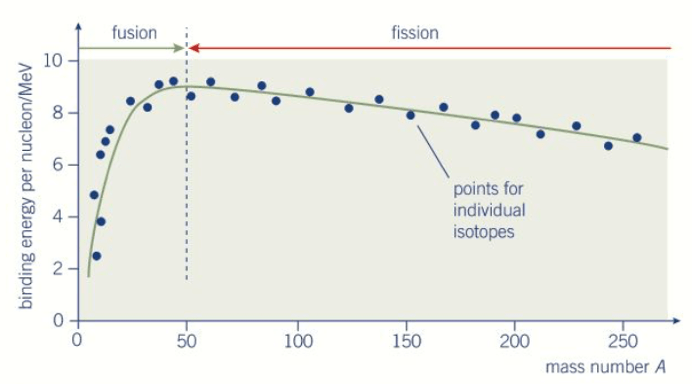
Source: Kerboodle A Level Physics Textbook
The graph above shows the average binding energy per nucleon vs nucleon number (mass number). Binding energy per nucleon is defined as ‘the average work done per nucleon to remove all of the nucleons from a nucleus.’ Nuclei with a higher binding energy per nucleon are more stable, this is because it takes more energy to separate out the constituent nucleons.
The maximum value on the graph is 8.7 MeV per nucleon, and this occurs between A = 50 and A = 60, nuclei within this range are most stable.
In fission – the binding energy per nucleon increases for the two produced fragments, so they are more stable.
In fusion – the parent nucleus formed from two daughter nuclei has more binding energy per nucleon. This means it is more stable. This holds true as long as the nucleon number of the nucleus produced is not larger than around 50.
Students may be expected to identify, on the plot, the regions where nuclei will release energy when undergoing fission/fusion.
The graph shows the areas of fusion and fission. Fusion takes place until around A = 50, at around 8.7 MeV.
Appreciation that knowledge of the physics of nuclear energy allows society to use science to inform decision making.
3.8.1.7 Induced fission
Content
- Fission induced by thermal neutrons; possibility of a chain reaction; critical mass.
- The functions of the moderator, control rods, and coolant in a thermal nuclear reactor.
- Details of particular reactors are not required.
- Students should have studied a simple mechanical model of moderation by elastic collisions.
- Factors affecting the choice of materials for the moderator, control rods and coolant. Examples of materials used for these functions.
Fission induced by thermal neutrons; possibility of a chain reaction; critical mass.
Induced fission was discovered when two scientists attempted to bombard uranium (the heaviest naturally occurring element) with thermal neutrons (neutrons not bound within an atomic nucleus) in an attempt to make it heavier, but noticed that in fact the nucleus split into two fragments of similar size, and two or three more neutrons were also released.
The process of fission releases energy which is utilised in power stations. It begins a chain reaction, as when induced fission occurs in U-235, it splits into two fragments and releases fission neutrons which can go on to cause a further fission event. This ultimately causes a chain reaction where these fission neutrons cause more fission events, which release more fission neutrons that cause more fission events, so can become uncontrollable under certain conditions. Each event releases a vast amount of energy that can be used in nuclear power stations.
For a chain reaction to occur, a ‘critical mass’ must be reached, ie the mass of fissionable material must be greater than this value of mass. This is because not all fission neutrons go on to cause fission, as some are absorbed by other nuclei without fission, and some escape the material without causing fission. Essentially, the point where the chain reaction can become self-sustaining is called the critical mass, where neutrons are not lost at a faster rate than they are formed.
The functions of the moderator, control rods, and coolant in a thermal nuclear reactor.
An example of a typical thermal nuclear reactor is shown below. Only knowledge of the moderator, control rods and coolant within the reactor is required for this specification. Although it is useful to learn further details to boost understanding.
The reactor core contains fuel rods, control rods and a coolant (water for example). This core is connected to a pressurizer and then heat exchanger where it can then be used to produce steam that can drive turbines and ultimately produce electricity. A pump is used to push the coolant into the core.
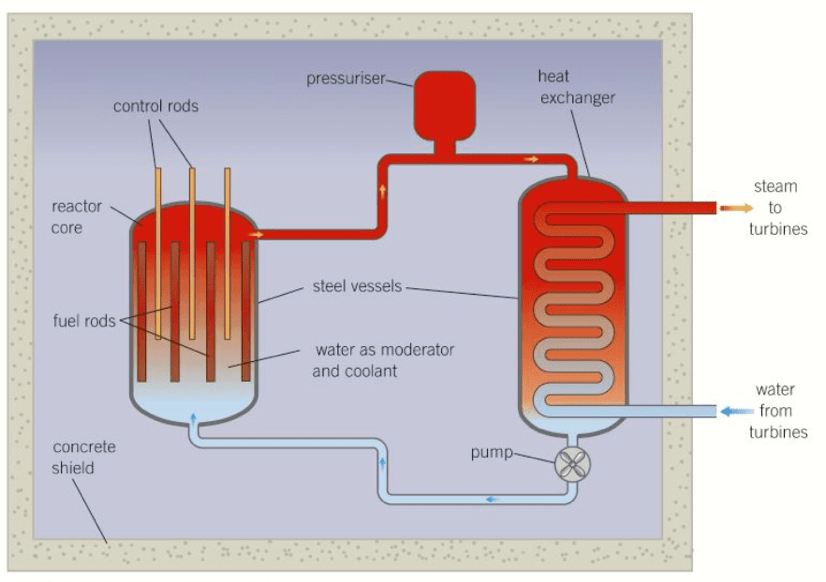
Source: Kerboodle A Level Physics Textbook
The fuel rods are so called because they contain the fuel, namely the fissionable U-235, but almost 98% U-238 (which is not fissionable).
The role of the control rods is to absorb neutrons. The depth of the control rods is varied remotely in order to regulate the number of fission neutrons in the reactor core so that the chain reaction does not become out of control. It is regulated to aim towards an average one fission neutron per fission will go on to produce another fission event. This also means the energy produced per unit time takes a fairly constant value. To absorb more neutrons, you must simply lower your control rods.
Also, if the neutrons travel to fast they are unable to cause fission, they need to be travelling at the correct speed which is regulated by the moderator. The moderator in this type of nuclear power station is water, which has the role of slowing neutrons down. The neutrons collide with the atoms of the moderator (water) thus slowing them down.
It is described as a ‘thermal’ nuclear reactor because fission neutrons are slowed to kinetic energies similar to that of the moderator molecules (to achieve a thermal equilibrium).
The water also acts as a coolant alongside its role as a moderator.
As mentioned already, the mass of fissionable material (U-235) must be at or above the critical mass.
Details of particular reactors are not required.
Students should have studied a simple mechanical model of moderation by elastic collisions.
In certain nuclear power stations, graphite is used as the moderator. It turns out that the most effective moderators are ones where the mass of the moderator atom is very similar to the mass of the neutron. This is because when they are similar, the neutrons kinetic energy after the collision is similar, but slightly smaller than before the collision, as the moderator atoms gain kinetic energy. (Overall kinetic energy remains the same in an elastic collision before and after the event).
If the neutrons are travelling too fast then their kinetic energy will be too high to be absorbed by a nucleus.

Factors affecting the choice of materials for the moderator, control rods and coolant. Examples of materials used for these functions.
The moderator used most commonly is water, but graphite can also be used. Moderators with atoms that have a similar mass to that of the neutron are chosen, for the reasons outlined in the above point. Control rods are chosen for their ability to absorb lots of neutrons without fissioning themselves ie boron or silver. The coolants are chosen to have a large specific heat capacity, so that they can absorb lots of energy without showing a significant change in temperature, hence the reason water is used. CO2 gas is also used.
3.8.1.8 Safety aspects
Content
- Fuel used, remote handling of fuel, shielding, emergency shut-down.
- Production, remote handling, and storage of radioactive waste materials.
- Appreciation of balance between risk and benefits in the development of nuclear power.
Fuel used, remote handling of fuel, shielding, emergency shut-down.
Nuclear reactors have various safety features, as they are potentially catastrophic. Take for example the Chernobyl disaster as evidence of this.
The reactor core must be made of very thick steel that can withstand extreme temperatures and high pressures. The thick steel vessel absorbs neutrons from the core as well as beta radiation and some gamma radiation. The actual core of the whole set up must be built with very thick concrete walls, as to absorb neutrons and the gamma radiation that escapes. Every reactor must also have an emergency shut-down, this inserts the control rods into the core to completely inhibit the fission process. Moreover, the handling of fuel must be done completely remotely. After use they emit beta and gamma radiation which is very dangerous, and before use they emit alpha radiation.
Production, remote handling, and storage of radioactive waste materials.
Radioactive waste comes in three forms, low, intermediate or high risk. The used radioactive waste can no longer be dispersed into the sea after dilution with water.
High-level waste like the used fuel rods are, as mentioned previously, removed remotely and then stored underwater to cool them. This occurs for over a year as they still decay radioactively, so still release heat. They are then stored in containers after the unused uranium/plutonium is extracted. They are usually stored in deep trenches/underground bunkers of sorts.
Intermediate-level waste can usually be sealed in containers enclosed by concrete. These are stored in buildings made with more reinforced concrete.
Low-level waste can be stored in small metal containers and buried in trenches.
 Marksphysicshelp
Leave a comment